

Thursday, 15 April 2010
Thank You

The Films
The next day was the last of the workshops, and the final thing we had to do was to edit the video footage that we made on the hills and reflect on the work we had done.
Luckily we had done some video editing earlier in the project so we could remember quite well how to do it and what programs we used.
We had already got the films off the flip cameras and Andy and Dave had converted them to make them work with Windows Movie Maker, so getting the films onto the Netbooks and to begin to edit them was a lot quicker than the last time.
It was fun to get a first look at the video we (and our machines) had made a few days before, again we thought about making a title for the films, which bits we should cut out, and which bits could have an effect applied to them to add emphasis to certain parts. Here are some screen shots from a few of the movies.
After doing the editing of our films we had a few thoughts about how we could have improved the machines, either making them differently with different materials, or where we would place them in order to make the best use of the recording equipment.
The main thing to come out of this was that we would need to make things slightly stronger as some of the machines weren't sturdy enough for the trip there, although they did work once they were repaired. Other ideas included making thing waterproof and making things secure so that we would be able to leave them for longer, in the environment.
Luckily we had done some video editing earlier in the project so we could remember quite well how to do it and what programs we used.
We had already got the films off the flip cameras and Andy and Dave had converted them to make them work with Windows Movie Maker, so getting the films onto the Netbooks and to begin to edit them was a lot quicker than the last time.
It was fun to get a first look at the video we (and our machines) had made a few days before, again we thought about making a title for the films, which bits we should cut out, and which bits could have an effect applied to them to add emphasis to certain parts. Here are some screen shots from a few of the movies.
Project Breaking Point, Short Show Reel from David Bethell on Vimeo.
After doing the editing of our films we had a few thoughts about how we could have improved the machines, either making them differently with different materials, or where we would place them in order to make the best use of the recording equipment.
The main thing to come out of this was that we would need to make things slightly stronger as some of the machines weren't sturdy enough for the trip there, although they did work once they were repaired. Other ideas included making thing waterproof and making things secure so that we would be able to leave them for longer, in the environment.
Out on the Hills
The penultimate day of the project was to go out onto Hednesford Hills and use our newly built machines to do our recordings.
The Hednesford Hills are an area of heath and woodland that are part of Cannock Chase, they are right next to the school and they are a great place to see wildlife. The hills are a nature reserve and have lots of interesting plants and animals living on them. There is Heather, Gorse, Oak, Pine and Birch Trees, Bilberry, and grasses. In the area we went to there was also a marshy pond which was alive with frogs. There are also cattle which help maintain the unique environment by eating the grass and invasive plants, these cattle are a breed called Dexters and they have very short legs.

The Hednesford Hills are an area of heath and woodland that are part of Cannock Chase, they are right next to the school and they are a great place to see wildlife. The hills are a nature reserve and have lots of interesting plants and animals living on them. There is Heather, Gorse, Oak, Pine and Birch Trees, Bilberry, and grasses. In the area we went to there was also a marshy pond which was alive with frogs. There are also cattle which help maintain the unique environment by eating the grass and invasive plants, these cattle are a breed called Dexters and they have very short legs.

Making the Final Pieces
Once the maquettes and were finished, we started to think about making the actual machines. For this part of the Andy and Dave brought in some new materials. Some of the materials were larger versions of what we had already used and some of them such as Duck Tape were new.
Again we had to do some planning before we started making, this was important to make sure that we made the best use of the materials we had and to make sure that we were safe when we were working.
We managed to make the final pieces within a day. It was hard work but we managed it in the end, although we had to do some quick finishing off on the next day.
Again we had to do some planning before we started making, this was important to make sure that we made the best use of the materials we had and to make sure that we were safe when we were working.
We managed to make the final pieces within a day. It was hard work but we managed it in the end, although we had to do some quick finishing off on the next day.
The Final Part
We are now coming to the end of the breaking point project, so we have started planning what we are going to make as a final piece of work.
Planning
Planning is very important when we are making work it makes sure we get all our ideas down and then have something to work to when we are making the work.
The brief for this end project was to find a way of recording or measuring the environment on the hednesford hills, which are next to the school. The idea was to make objects which were half machine half sculpture.
Planning
Planning is very important when we are making work it makes sure we get all our ideas down and then have something to work to when we are making the work.
The brief for this end project was to find a way of recording or measuring the environment on the hednesford hills, which are next to the school. The idea was to make objects which were half machine half sculpture.
Wednesday, 24 February 2010
Mini Masterpieces

At the end of the day we used the NetBook computers to transfer the film from the camera and onto the school's network. We had a bit of trouble with this because of the space available and the number of film we had made.
Zoetropes
Zoetropes are quite an old way to make images appear to be moving or animated, they were first made in the form that we recognise in the 19th century, however the idea goes back to ancient china.
we wanted our Zoetropes to tell a story, it was a story of going to get some food, and the animations would relate to the three different ages.
Andy and Dave had made some examples and a zoetrope made from lego, two old CDs, a CD stack box and some card.
Here is a drawing of the zoetrope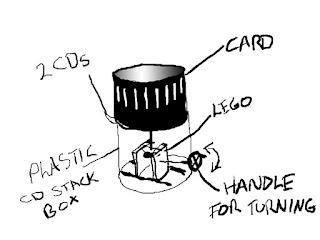
we wanted our Zoetropes to tell a story, it was a story of going to get some food, and the animations would relate to the three different ages.
Andy and Dave had made some examples and a zoetrope made from lego, two old CDs, a CD stack box and some card.
Here is a drawing of the zoetrope

Wednesday, 2 December 2009
Web Albums

During this project we will be uploading photographs and video onto Google Picasa web albums, this will allow anyone to look at the images download them, print them, or use them however they want...
http://picasaweb.google.com/airspacegallery/BreakingPointPhotostream?feat=directlink
This is the link to the web album, the images on here are much bigger than we can put on the blog so they are therefore much higher quality.
Also on the blog is a 'Photostream' which shows random selections of images from this album, you can also get to the album by clicking on these images.
The picasa web albums logo is the property of google, and is used here as illustration only.
Tuesday, 1 December 2009
Making a blog title
Monday 30th November

This was our third session, and last before Christmas. Today we had a look at this blog again, we had a look at the page layout, and thought about what could be added, we also had a look at the other pages that have been added so far.
One of the main items that we looked at was the blog title, everyone thought that it was a bit boring just having text, so today we made some funky graphics which you can now see above.

This was our third session, and last before Christmas. Today we had a look at this blog again, we had a look at the page layout, and thought about what could be added, we also had a look at the other pages that have been added so far.
One of the main items that we looked at was the blog title, everyone thought that it was a bit boring just having text, so today we made some funky graphics which you can now see above.
Saturday, 28 November 2009
Blogging
A key part of this project is this blog. It is going to be our place for sharing what we are doing during the project with the wider world. As the project progresses we will be adding all sorts of things to this website, such as images, text written by people involved, videos documenting the work, and some artwork itself. This will hopefully give people lots of ideas about how technology of all sorts can be used in a creative way to produce an exciting and vibrant environment. In the meantime here is a bit of information about blogging.
Boats
Thursday 26th November

Today we had a go at making a simple mode of transport, in this session we were exploring means of communication. The boat as a mode of transport is itself a means of communication, but during the task we asked for different methods of communication to be explored, in the form of a manual to enable another group to be able to reconstruct the boat design.
The session began with a quick introduction to types of boats and what materials could be used to manufacture them.

Today we had a go at making a simple mode of transport, in this session we were exploring means of communication. The boat as a mode of transport is itself a means of communication, but during the task we asked for different methods of communication to be explored, in the form of a manual to enable another group to be able to reconstruct the boat design.
The session began with a quick introduction to types of boats and what materials could be used to manufacture them.
Wednesday, 25 November 2009
Towers and Bridges
Monday 23rd November

This was the first day of work at the school, after a brief presentation from AirSpace Gallery artists and PiCL. We all got down to doing some quick experiments.
First each class was divided into three groups. These groups were given names based on points of history, these were; Primitive, Egyptian, and Modern.
The task that each group had to complete was to build a basic structure using materials relevant to their particular point in history.

This was the first day of work at the school, after a brief presentation from AirSpace Gallery artists and PiCL. We all got down to doing some quick experiments.
First each class was divided into three groups. These groups were given names based on points of history, these were; Primitive, Egyptian, and Modern.
The task that each group had to complete was to build a basic structure using materials relevant to their particular point in history.
Introduction
To mark the beginning of the project, AirSpace Gallery and St. Peters Primary School invited parents and the year three pupils to attend a presentation introducing the project, AirSpace Gallery and PiCL.


Wayne Thexton represented PiCL and gave an introduction to parents and the school about AirSpace Gallery (David Bethell and Andrew Branscombe) and the project.
The presentation then went on to look at artists working with Technology and gave an introduction to the project.

Work by Shaun Doyle and Mally Mallinson from Ecce Homo Tesco Exhibition

Work By Alex Pearl, automatic filming
The Projects will look at technology and its history by exploring various inventions and materials from different ages. These ages will be explored through a primitive age, Egyptian age and Modern age.
The Pupils will also have to use materials and techniques that relate to one of the three particular ages in order to carry out experiments and tests.
The first sessions involves making a tower and a bridge.
About St Peters
St Peter has 427 pupils and has the motto 'Reach for the Sky', the school is located next to Cannock Chase, in Hednesford. To find out more about the school please visit their website.
About PiCL
PiCL aims to meet national Creative Partnerships objectives and to compliment creative learning and cultural strategies for children and young people in the area. PiCL aims to develop creative work through three main areas; project management, consultancy and advisory services and development.
About AirSpace Gallery
AirSpace Gallery was Stoke on Trent First Contemporary Art Gallery, the space is place for the production and consumption of Contemporary Art. AirSpace Gallery has exhibited the likes of Richard Hughes, Mariele Nuedecker, Alex Pearl, Shaun Doyle and Mally Mallinson, Johanna Hällsten, Littlewhitehead and Alex Frost. AirSpace Gallery was opened on March the 19th 2006 By Martin Creed and his band Owada.


Wayne Thexton represented PiCL and gave an introduction to parents and the school about AirSpace Gallery (David Bethell and Andrew Branscombe) and the project.
The presentation then went on to look at artists working with Technology and gave an introduction to the project.

Work by Shaun Doyle and Mally Mallinson from Ecce Homo Tesco Exhibition

Work By Alex Pearl, automatic filming
The Projects will look at technology and its history by exploring various inventions and materials from different ages. These ages will be explored through a primitive age, Egyptian age and Modern age.
The Pupils will also have to use materials and techniques that relate to one of the three particular ages in order to carry out experiments and tests.
The first sessions involves making a tower and a bridge.
About St Peters
St Peter has 427 pupils and has the motto 'Reach for the Sky', the school is located next to Cannock Chase, in Hednesford. To find out more about the school please visit their website.
About PiCL
PiCL aims to meet national Creative Partnerships objectives and to compliment creative learning and cultural strategies for children and young people in the area. PiCL aims to develop creative work through three main areas; project management, consultancy and advisory services and development.
About AirSpace Gallery
AirSpace Gallery was Stoke on Trent First Contemporary Art Gallery, the space is place for the production and consumption of Contemporary Art. AirSpace Gallery has exhibited the likes of Richard Hughes, Mariele Nuedecker, Alex Pearl, Shaun Doyle and Mally Mallinson, Johanna Hällsten, Littlewhitehead and Alex Frost. AirSpace Gallery was opened on March the 19th 2006 By Martin Creed and his band Owada.
Subscribe to:
Posts (Atom)